One Train, Two Destinations: The Interrail Habit That Stops You Boarding the Wrong Half
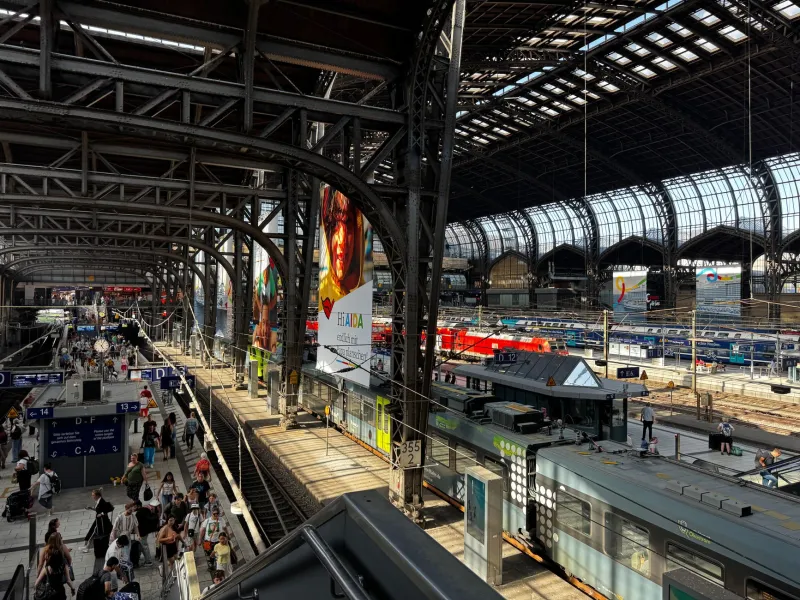
There is a particular kind of travel anxiety that only appears when the platform announcement says something like: this train divides at the next junction. The front coaches continue to one city; the rear coaches go somewhere completely different. For a UK Interrailer used to a train being one train, this can sound like a riddle. But split trains are not a glitch. They are a routine way of running railways in Germany, Switzerland, the Netherlands, Denmark and beyond. On a 2026 Interrail trip, the trick is to learn the ritual before you board, not after the doors close.
What a split train actually is
A split train — sometimes called portion working, a dividing service or, in German, a Flügelzug — leaves a major station as one physical train, then divides at a junction. The front set might continue to one city, while the rear set heads somewhere else entirely. To the passenger, it can look like one long train with one train number. To the railway, it is two services sharing a path for part of the journey.
This happens because it is efficient. Instead of running two half-empty trains from a big hub, operators combine them and send each portion where demand exists. On an Interrail trip, it can be brilliant: you get a direct-looking connection without changing. It can also be a trap if you sit in the wrong half.
The 60-second pre-boarding check
Before you step onto any train in Europe, especially a long-distance one, run a simple three-part check. It takes less time than finding a seat.
-
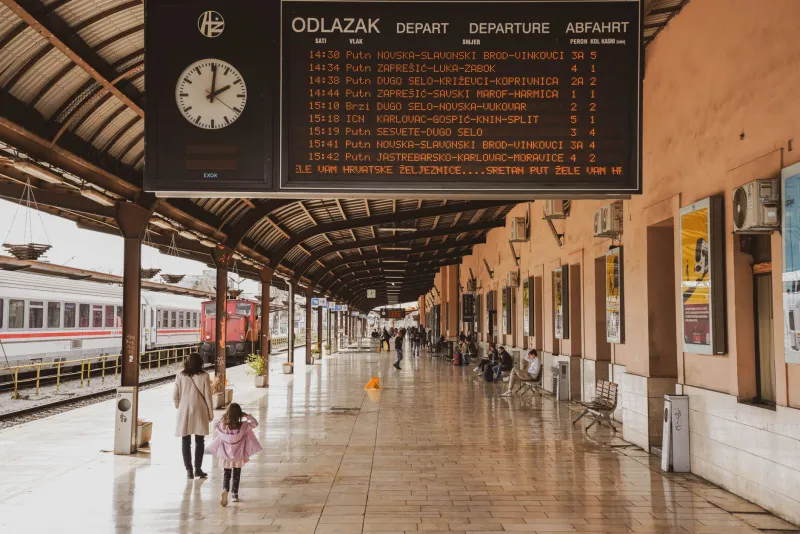
Check the departure board for more than one destination. A normal train shows one terminus. A split train may show two, perhaps alternating, or a note such as 'portion to...' or 'rear coaches to...'. In Germany look for Zugteilung. In Switzerland, Zugstrennung. In the Netherlands, the train may be shown as two destinations, such as Leeuwarden and Groningen.
-
Check your coach letter. Your Interrail reservation, if you have one, will usually name a coach — Wagen in German, voiture in French, rijtuig in Dutch. That letter is not a suggestion. It tells you which physical part of the train you need. If you have no reservation, the platform display or the train formation diagram in the operator's app will show where each coach ends up.
-
Check the carriage itself. Before boarding, look at the destination displays above the doors or on the side of the carriage. On older stock, there may be paper labels. If one carriage says München and the next says Stuttgart, you are looking at a split train. Board the one that matches your route.
If any of those three checks disagree, ask staff on the platform. A quick 'Does this coach go to...?' is never a silly question. The silly question is the one asked from the wrong side of a junction.
Read the board, not just the platform number
Split trains often confuse people because the platform number is correct. The train is going to your destination — just not every carriage. Departure boards in mainland Europe sometimes show the service as one line with two destinations, or as two lines sharing a platform and time. Read the small text. Look for the word 'portion', 'section', 'rear', 'front', or the local equivalent. If the board says the train divides, assume you need to know which part you are in.
A good habit is to check the operator's app before you reach the station. DB Navigator, SBB Mobile, NS App and similar tools often show the train formation, including coach letters and where the train splits. Screenshot it. Station Wi-Fi is not always reliable, and a screenshot is a calm thing to have in your pocket when the platform is busy.
Coach letters are part of the route
In the UK, coach letters are mostly about reservations. On a split train, they are about geography. Coach A might go to one city, coach C to another, and coaches B and D might be closed or attached elsewhere. That is why a reservation for coach C is not just a seat — it is a direction.
If you are travelling with an Interrail pass and no reservation, you still need to choose the right carriage. Look for the formation displays on the platform. They often show a little train diagram with letters and destinations. If there is no display, watch which way other passengers with reservations are walking, or ask the conductor at the door. Do not assume the front of the train is the main part. On some routes, the rear portion is the longer one.
Onboard: listen, look, ask
Once aboard, keep one ear open for announcements. They usually come before the split station, often in multiple languages. Listen for the station name and the word for divide or rear coaches. If you do not understand the language, watch the onboard displays. Many trains scroll the destination of each coach.
If you realise you are in the wrong half, act before the split. Find the conductor and explain. On some trains you can walk through to the correct portion at a station stop; on others, the doors between portions are locked. The conductor may advise you to change at the junction and wait for the next service. That is rarely a disaster on an Interrail trip, but it is a lot more pleasant if you catch it early.
If you end up on the wrong half
It happens. The train divides, your carriage heads west while your plan heads east, and you are suddenly on an unplanned branch line. Do not panic. Get off at the first station where the portion stops, check the timetable, and rebuild. Interrail passes are flexible, and a wrong-half detour is often just a coffee and a wait. If you have a reservation on a later train, speak to staff — most operators are used to this mistake and will help you rebook or endorse your ticket.
Make it part of route planning
The best defence is to build split-train awareness into your route planning. When you look up a connection, check whether the service divides. If it does, note the coach letter and the split station. Give yourself a few minutes of buffer at the station rather than arriving at the last second. And if you are changing trains at a junction where portions separate, double-check that your connection is from the same portion, not the other one.
Split trains are one of those European rail habits that feel exotic until they become second nature. Learn the check, read the coach letter, and listen for the divide. Then you can enjoy the clever bit — one train, two destinations — without becoming the passenger who accidentally reviews the wrong city.