Seven Underrated Rail Hubs Worth Turning a Layover Into a Night
Every Interrail map starts the same way. St Pancras, a Eurostar, then Paris or Brussels, then a line that touches Amsterdam, Berlin, Prague and Rome in roughly the order the guidebooks suggest. No shame in that — those cities earned their reputation. But underneath them sits a whole tier of stations that are big enough to have left luggage and a train every hour, and small enough that you can walk out of the doors and be somewhere interesting in fifteen minutes.
These seven are the ones worth building a night around. All of them sit on routes you were probably going to travel anyway, all of them have somewhere to leave a bag, and none of them will charge you nine euros for a coffee.
1. Liège-Guillemins, Belgium
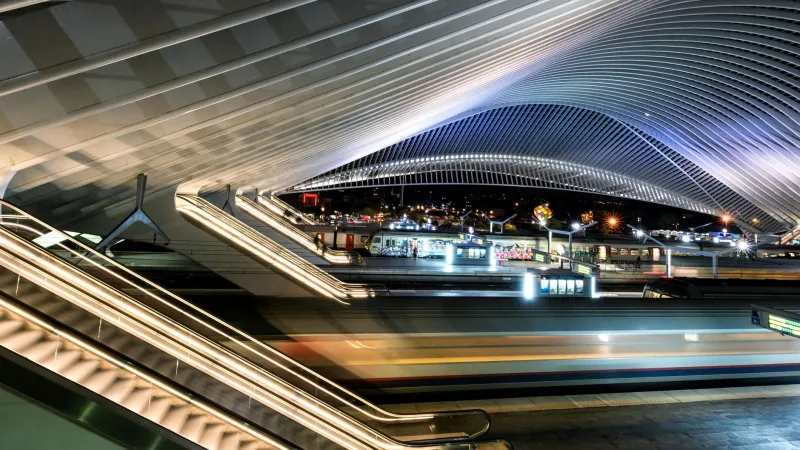
Calatrava's glass-and-steel terminal opened in 2009 and still looks like it landed from a different decade. It is genuinely worth the stop on architecture alone — but the real reason to get off here is that Liège is where Belgian prices meet German, Dutch and French connections. The station sits about two kilometres above the old town, far enough to keep the crowds away and close enough to walk (20 minutes, uphill, so budget for that), or hop on a bus.
Bags and onward: lockers on the concourse, a handful of cafés, a supermarket nearby. Brussels is an hour away, Cologne just over an hour on the ICE, Maastricht about half an hour, Paris a couple of hours by TGV. Hotels around the station are noticeably cheaper than anything comparable in Brussels — think €60-80 for a decent double, less in the city's hostels. Climb the 374 steps of the Montagne de Bueren, eat a waffle, sleep, move on.
2. Dijon-Ville, France
Dijon is the answer to a question most Interrailers never think to ask: what if I broke the Paris–Lyon run in half? The station is a ten-minute walk from the Palais des Ducs, the brass owls of the Parcours de la Chouette set into the pavement, and more mustard shops per square metre than anywhere on earth. It is also a proper junction, with trains fanning out towards Switzerland, Marseille and the Alps.
Bags and onward: lockers, a brasserie on the concourse, trams if you're carrying too much. Paris in 1h40, Lyon in under two hours, Basel around two, Marseille about three and a half. TER regional services need no reservation; TGVs do. A dorm bed costs roughly €30, a hotel double €75-90, and dinner is a very reasonable affair if you dodge the owl-themed tourist traps and head for the side streets near the market.
3. Olomouc, Czechia
Prague gets the stag dos. Olomouc gets a UNESCO-listed centre, an astronomical clock with a Soviet-era twist and beer that costs less than a London flat white. It is a little over two hours from Prague on a Pendolino, which makes it an obvious place to break the journey east — or a base for a couple of nights once you realise how far your money goes.
Bags and onward: the station has lockers and a supermarket in the underpass; trams reach the centre in five minutes, or it's a 20-minute walk. Prague, Brno and Ostrava are all within a few hours, and Vienna is a straightforward run via Břeclav. Kraków is around four hours through Katowice. Dorm beds run €15-20 and a sit-down dinner with a beer is comfortably under €15.
4. Wrocław Główny, Poland
The station itself is the attraction: an 1850s building restored to within an inch of its life, with a beer hall downstairs and more platforms than a city this size has any right to. Twenty minutes on foot gets you to the Rynek, one of the prettiest market squares in Poland, and to the several hundred bronze dwarfs hiding around the streets.
Bags and onward: lockers and left luggage inside, trams from the forecourt. Berlin and Dresden are three to four hours, Prague four, Kraków three. Poland is where an Interrail budget suddenly relaxes — €25-35 dorms, €8 dinners, and a tram ticket that costs less than a supermarket meal deal.
5. Linz, Austria
Everyone between Salzburg and Vienna falls asleep and wakes up in Vienna. Linz is the third city in that corridor and has quietly become one of the more interesting stops in Austria: the Ars Electronica Center on the riverbank, the Pöstlingberg tram grinding up the hill, and a Danube waterfront far more pleasant than its industrial reputation suggests.
Bags and onward: lockers in the station, a bakery and a supermarket, and a tram from the forecourt to Hauptplatz in about 15 minutes. Salzburg in an hour, Vienna in 1h20, Munich in two. Hostels sit around €25-35, and the streets behind the station hide cheap hotels that never make the glossy Austria guides. If your route is Munich to Vienna, this is an almost-free extra night.
6. Verona Porta Nuova, Italy
Verona's station is a scruffy-looking thing for a city this pretty — and that's exactly the point. Nobody treats it as a destination, which means affordable beds, an easy walk into one of Italy's best-preserved centres, and a platform that puts half the country within day-trip range. It's 15-20 minutes on foot across the river to the Arena, or a short bus if you're lugging a big pack.
Bags and onward: lockers, a bar that stays open late, a supermarket downstairs. Venice is an hour, Milan 1h20, Bolzano 1h40, Innsbruck about two and a half via the Brenner, Munich around five. Regional trains towards Venice need no reservation — handy when you're tired of paying supplements — while Frecciarossa services do. It's cheaper than Venice by a mile and better connected than the lake's own stations.
7. Ljubljana, Slovenia
Ljubljana's station is a ten-minute walk from the Triple Bridge, past a station square that has been rebuilt into something almost pleasant. The city is small, green and walkable, with a castle on a hill and a river lined with cafés — the sort of place where a one-night stopover quietly turns into three.
Bags and onward: lockers, a bakery, a supermarket, and bike hire a couple of minutes away. Zagreb is 2h20, Trieste and Venice are a few hours west, Vienna via Graz is a long but beautiful day, and Budapest is a direct run if you time it right. Lake Bled is roughly an hour by bus. Hostels run €25-35. Do check timetables for the Trieste link — it's the connection that changes most often.
How to slot these in from the UK
The easy starter is Eurostar to Brussels, then Liège the same afternoon and Cologne or Frankfurt the next morning. You've seen the Ardennes, slept cheaply and skipped a night of Brussels pricing. Heading east, Brussels–Berlin–Wrocław–Olomouc–Vienna is a natural chain, and from Vienna you can drop into Ljubljana or push down to Verona before looping home via Munich and Paris.
The budget maths
A capital-city dorm in July costs roughly what a private double costs in Olomouc or Wrocław. Add the fact that smaller hubs rarely require a reservation-heavy high-speed train to reach — regional and secondary services are usually pass-friendly — and the savings compound quickly. Budget €2-6 for a locker, and check the last tram before you commit to a late arrival.
One small caveat
Small stations aren't always open all night, and left luggage isn't universal. Check before you travel, keep half an eye on the clock, and don't plan a 5am departure from a town whose station shuts at midnight.