Platform Pending: How to Read a European Departure Board Before It Names Your Train
Photo: Sanqui, CC0, via Wikimedia Commons
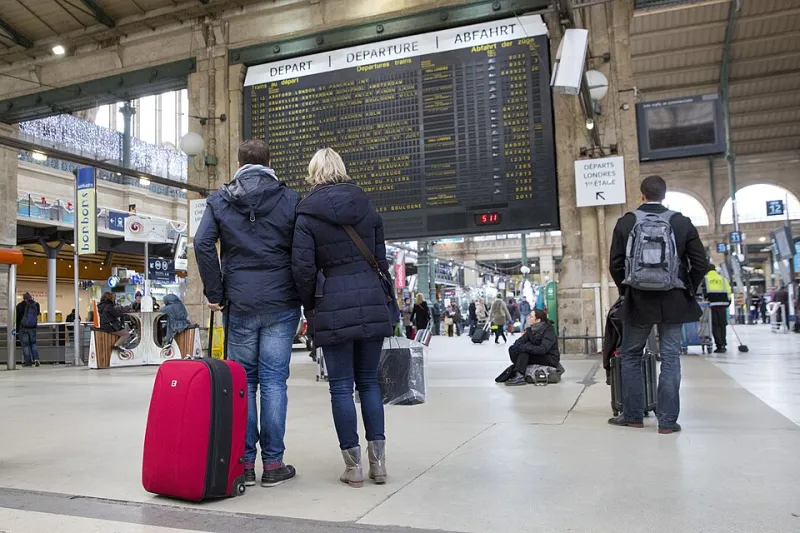
You are standing under the departure board at Paris Gare du Nord. Your train to Amsterdam is listed, the time is right, the destination is right, and the platform column simply says 'TBC'. Around you, people are doing the same thing: glancing up, glancing at their phones, glancing at the clock. Then the number appears and the concourse does a small, polite stampede.
If you are used to a UK station where the platform often appears a comfortable ten minutes before departure, this can feel like a test. It is not. At many European hubs, a late platform number is normal station life. The trick is to stop treating the blank as a crisis and start treating it as a cue to get into position.
Why the board holds its tongue
A platform number is not just a label. It is an operational promise. At big stations such as Paris Gare du Nord, Milan Centrale and Cologne Hbf, the platform is often confirmed only once the incoming train has arrived, been cleaned, been checked and been given the green light by the signalling and station teams. Add in tight turnarounds, coupled trains, short platforms and a busy throat of tracks outside, and the station simply will not name a platform until it is confident.
That is why the board can feel deliberately mysterious. It is not. It is being cautious. The number is being held back because the station does not want to send hundreds of passengers to the wrong place. Once you accept that, the waiting game becomes a lot less annoying.
Read the board like a local, not a tourist
Most travellers look only at the destination and the time. That is understandable, but it is not enough. A European departure board is a small information system, and the platform is only one part of it.
Start with the train number. It is usually printed next to the destination, and it is the detail that saves you when two trains leave for the same city within minutes of each other. Then look at the remarks column. Words such as 'retard', 'ritardo' or 'Verspätung' tell you the train is running late, which often explains why the platform is still blank. Coach letters or formation notes may also appear there, and they matter if you have a seat reservation in coach 12.
Finally, check whether you are looking at a departure board or an arrival board. At a glance they can look similar, especially after a long journey. The last thing you need is to sprint for a platform that is actually receiving a train from the other direction.
The three-screen rule
At a major station, use three sources in this order: the main station screens, your rail app, and a human being. The screens are the official source. Apps are useful, but they can lag behind or show a platform that is still provisional. Staff announcements cut through both, especially when something changes at the last minute.
Do not spend the whole wait refreshing your phone. Instead, find a spot where you can see a screen without standing directly under it. At Paris Gare du Nord, that often means the main concourse rather than the far ends of the platform area. At Milan Centrale, the central hall under the huge arch gives you sightlines to the boards and a quick route to the gates. At Cologne Hbf, the main hall does the same job. Think of it as choosing a control point, not a waiting place.
Where to stand before the number appears
The best waiting spot is not the closest spot to any one platform. It is the spot that lets you move in more than one direction. Stand near the main information cluster, keep your bags mobile and avoid getting trapped in a cafe queue or a far corner of the concourse.
If you are travelling with a big backpack, put it on your back rather than at your feet. If you are with a group, agree a meeting point in case the platform changes. And keep your ticket or pass somewhere you can reach without taking everything off. The goal is simple: when the number appears, you should be able to walk with purpose rather than start a small packing project.
The five-minute drill
When the platform finally appears, do not just run. Confirm the destination, the departure time and the train number. Check the coach letter if you have a reservation. Then move.
If the platform changes while you are walking, stop and look at the nearest screen. Do not keep going on momentum. European stations often have repeated boards near the platform entrances, and they are there for exactly this reason. If you are already on the platform when the change is announced, get off and follow the flow rather than waiting for an English-language announcement that may never come.
Learn three platform words
You do not need to speak French, Italian or German to board a train. But three words help: 'voie' in French, 'binario' in Italian and 'Gleis' in German. They all mean platform or track. Once you can recognise them in an announcement, you will hear your train even when the rest of the sentence is a blur.
At staffed information desks, ask for the train number as well as the destination. It is faster and less ambiguous. And if you are unsure, ask another passenger who looks like they are waiting for the same train. Station communities are usually helpful, especially when everyone is watching the same blank column.
Build a buffer, not a sprint
A late platform number is much easier to handle with a buffer. At a big hub, aim to be in the concourse 30 to 40 minutes before departure. At a smaller station, 20 minutes is often plenty. That buffer is not wasted time. It is your insurance against a late platform, a long walk to the far end of the station and the kind of platform change that turns a relaxed traveller into a cartoon sprint.
The calm boarding is not the one where you guess correctly. It is the one where you are already in the right part of the station, with your ticket ready and your bags on your back, when the number appears. In 2026, that is still the most useful Interrail skill of all.